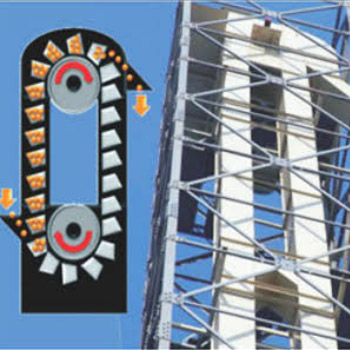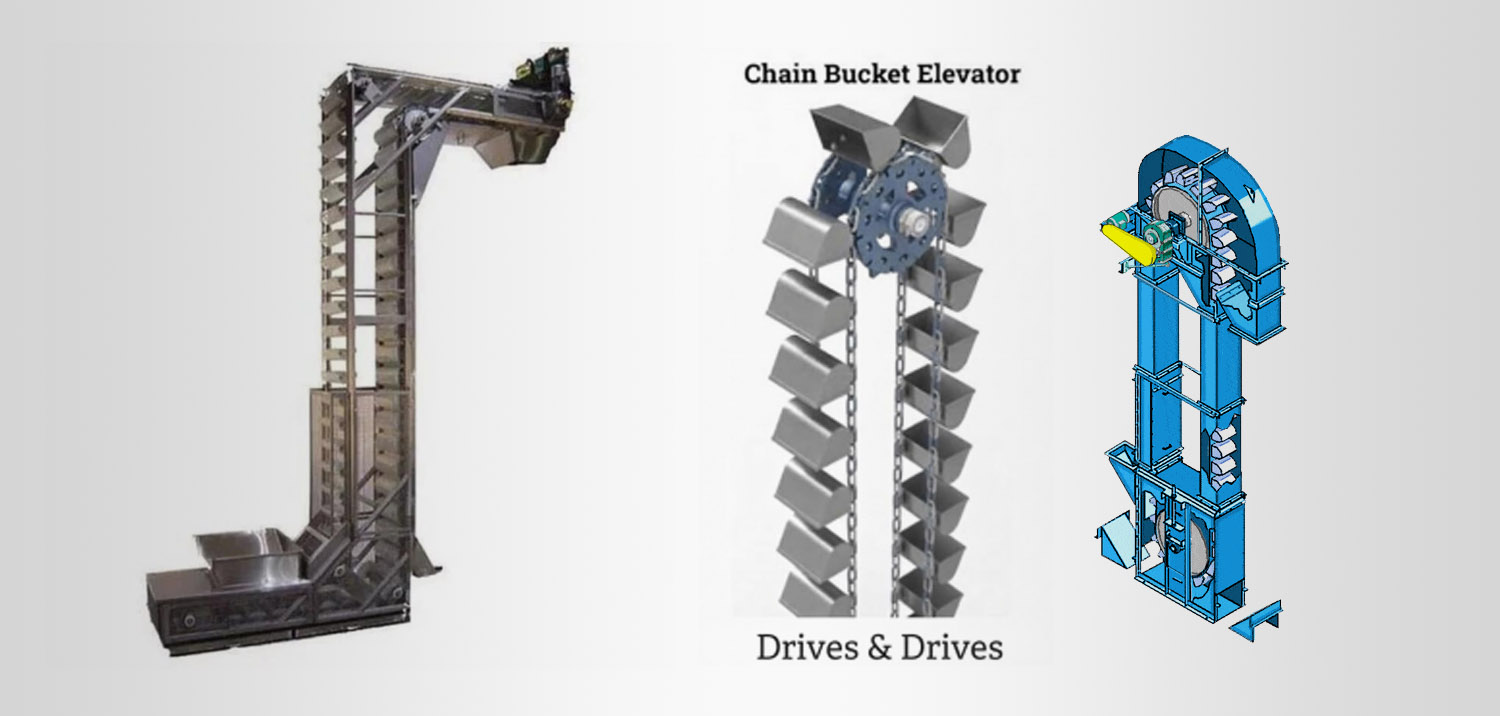
A bucket elevator (also called a grain leg or vertical lift) is a heavy - duty mechanical elevating system used to vertically transport bulk materials, powders, granules, or small lumps from a lower level to an upper level. It uses a continuous loop of belt or chain equipped with a series of spaced buckets that scoop up material from a boot (bottom inlet), lift it vertically inside a steel housing (casing), and discharge it at the head (top outlet).
Types of Bucket Elevators :
- Centrifugal Discharge Elevators : The most common type, where buckets are spaced apart on a belt or chain. As they pass over the head pulley, centrifugal force throws the material out of the buckets into the discharge chute. They operate at higher speeds and are ideal for free-flowing, light-to-moderate bulk materials.
- Continuous Discharge Elevators : Buckets are mounted closely together (almost touching) without gaps. At the discharge point, the inverted front of the preceding bucket acts as a chute to guide material smoothly out, preventing breakage. They operate at slower speeds and are used for fragile, abrasive, or sluggish materials.
- Super-Capacity Elevators : Heavy-duty continuous elevators designed with overlapping, V-shaped steel buckets capable of handling massive throughputs of extremely heavy, abrasive ores and minerals under severe industrial conditions.
Uses and Industrial Applications :
- Agriculture and Grain Handling : Elevating massive quantities of wheat, corn, seeds, and animal feed into storage silos, grain elevators, and processing mills.
- Cement and Aggregate Plants Transporting raw limestone, clinker, fly ash, sand, and gypsum between grinding and mixing stations.
- Mining and Minerals : Lifting crushed ores, coal, gravel, and heavy aggregates up to screening or washing towers.
- Chemical and Fertilizer Production : Moving chemical powders, granulated fertilizers, and raw minerals reliably across multi-tier processing plants.